
sound · Higher Occupational Certificate
Higher Occupational Certificate: Sound Operator
The Sound Operator programme — sound engineer, audio producer, sound technician and beyond. An occupational qualification: you learn the job by doing the job.
- NQF level
- 5 · 145 credits
- Duration
- 18 months · full time · Bloemfontein
- Structure
- Knowledge 40 cr · Practical 65 cr · Workplace 40 cr
- Workplace block
- 400 logged hours · Statement of Work Experience · EISA national exam
- Fees
- From R3 400/month · full fee structure
- 2027 intake
- 7 February 2027 · applications open
Theory, practice,
then the real world.
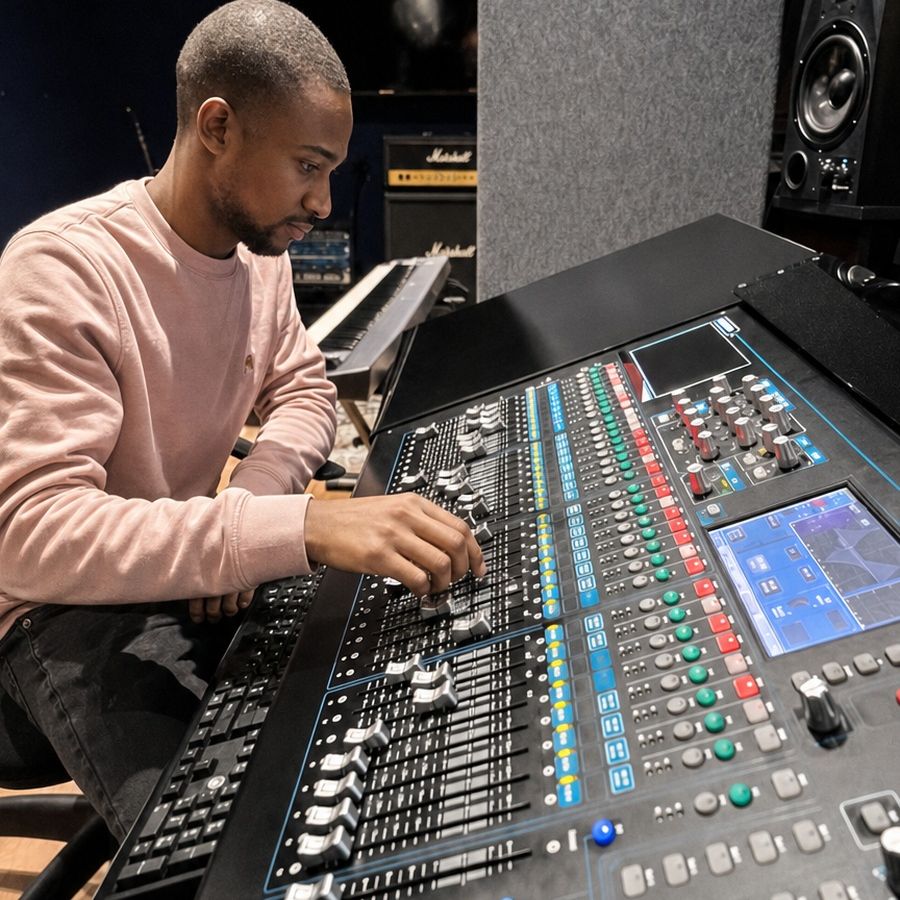
Knowledge modules (40 cr) build the theory of sound, signal flow and production; practical modules (65 cr) put you behind the desk in the recording studio, production lab and live production room; the qualification closes with a 400-hour workplace-integrated learning block (40 cr) and the national EISA exam.
- Knowledge modules
- 40 credits — the theory of the craft, in class and on the learning platform
- Practical modules
- 65 credits — supervised production work in PASMA's studios and labs
- Workplace block
- 40 credits — 400 logged hours in a real workplace
Assessment & the EISA
Occupational qualifications end in the External Integrated Summative Assessment (EISA) — a national exit exam, set and quality-assured nationally, not by the college. That is what makes the certificate portable.
Before you can sit it, you submit your Statement of Work Experience: the verified log of your 400 workplace hours. PASMA arranges and supervises the placement.
Entry requirements
NQF 4 with Communication and Mathematical Literacy. Unsure whether your subjects qualify? Ask admissions.
Registered. Quality-assured. Checkable.
- SAQA ID
- 120748 — view the listing ↗Listing reference being re-verified for the 2027 intake.
The full number, up front.
Every figure below is rendered from the published 2027 fee schedule, last reviewed 2026-08-12. The complete structure — instalments, workplace-block pricing, short courses — lives on the fees page.
A once-off enrolment fee secures your place (limited by studio capacity). Workplace-integrated learning months are billed at the standard monthly rate.
Complete fee structure ↗Where this
takes you.
Where you train
Who it's for
School leavers who want to run sound in studios, venues and broadcast — and learn by doing it daily, on industry-standard gear, from the first week.
Who it's not for
Anyone looking for a theory-only correspondence course; this programme is studio-floor intensive and full-time on campus in Bloemfontein.
Try a free activity
Real exercises from how we teach — free in your browser, no account needed for level 1.
- Frequency Recognition Trainer ↗Identify boosted frequency bands in pink noise across the audible spectrum
Asked and answered.
Is the Sound Operator qualification accredited?
Yes. It is a Higher Occupational Certificate at NQF level 5, quality-assured by the QCTO with MICTSETA as Assessment Quality Partner. The SAQA listing (ID 120748) is linked from this page — note the listing reference is being re-verified for the 2027 intake and is marked accordingly.
What is the workplace block?
The final phase places you in a real workplace for 400 logged hours. Your Statement of Work Experience — the log of those hours — is required before you can sit the national EISA exam.
What is the EISA?
The External Integrated Summative Assessment is the national exit exam for occupational qualifications, set and quality-assured nationally. You write it after completing your knowledge, practical and workplace modules.
Do I need my own equipment?
No. Training happens in PASMA's studios and production labs on industry-standard equipment. Many students choose to build a small home setup alongside, but it is not required.
Run the desk.
Spaces are limited by studio capacity.
Entry: NQF 4 with Communication and Mathematical Literacy.